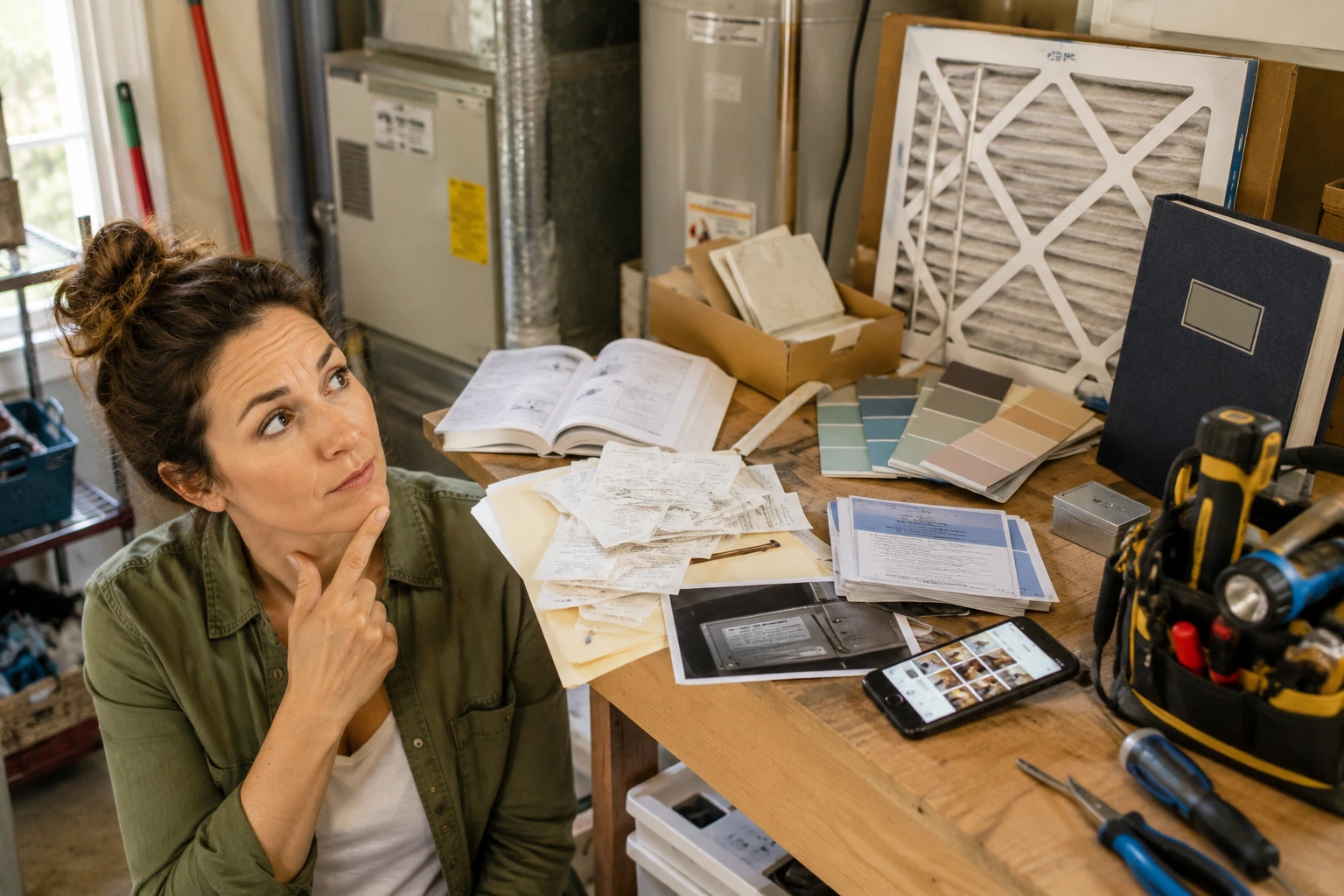
I never think about the model number on an appliance while it is behaving itself. I become deeply interested in that model number only after the machine stops working and the tiny label is wedged against a wall, under a door, or somewhere that requires both a flashlight and unreasonable flexibility.
The same thing happens with paint colors, contractor invoices, flooring names, warranties, filter sizes, and insurance photos. They feel like clutter until the exact moment they become proof, instructions, or the difference between one phone call and an entire afternoon of detective work.
I used to keep household records in a sophisticated system known as “several drawers and maybe my email.” That system performed exactly as well as it sounds.
Faye’s rule: If a record could help prove what I bought, who worked on it, or what is installed in the house, I save it before I need it.
I do not keep everything
A useful home-record system is not a museum of every instruction sheet and receipt that has entered the building. I keep records that can answer a future question about ownership, coverage, maintenance, repair, replacement, resale, or an insurance claim.
The goal is retrieval, not accumulation. A smaller set of clearly named records is more useful than six boxes of paper nobody can search.
My practical system has four groups: property and insurance, major purchases, repairs and improvements, and household reference details. Legal, tax, insurance, warranty, and permit requirements vary, so I treat official policies and professional advice as the authority when a specific rule matters.
The appliance records I save on the first day
For major appliances, I save the receipt, written warranty, service contract if there is one, model number, serial number, installation date, installer information, and any useful manual. I also take a clear photo of the model-and-serial label before the appliance is pushed into place.
A readable label photo is often more useful than the entire paper manual. It lets a repair company identify the exact product, helps with parts searches, and gives me the information needed to check warranty coverage or recalls.
The Federal Trade Commission recommends saving a copy of a product warranty and keeping the receipt with it because the receipt can establish the purchase date and original ownership. That is also why I keep the contract and confirmation for any extra coverage after reviewing what I check before paying for an extended warranty.
Official guidance: Federal Trade Commission warranty guidance.
I keep a repair history, not just the latest invoice
For repairs, I save the date, symptoms, diagnosis, work performed, parts installed, technician or company, amount paid, and written warranty on the work. If the invoice only says “service,” I add a short note while I still remember what actually happened.
A repair history shows patterns that a single invoice cannot. It helps me see whether a problem is recurring, whether the same component keeps failing, and whether another repair is sensible.
That record is especially useful when working through whether to repair or replace a major appliance. It also keeps me from paying a new technician to rediscover work that was already done.
For contractors, I save the scope and the proof
For roofing, HVAC, plumbing, electrical work, remodeling, and other significant services, I keep the written estimate, signed contract, final invoice, payment record, work scope, product information, warranties, change orders, permits, inspection records, photos before and after the work, and the contractor’s contact details.
The useful record is not merely what I paid; it is what the company agreed to do. A detailed scope can clarify materials, quantities, model numbers, exclusions, disposal, cleanup, and warranty responsibilities.
The FTC advises keeping notes and copies of letters and documents when resolving a home-improvement problem. I apply the same discipline before trouble starts and use the comparison questions from the home services I compare before saying yes.
Official guidance: FTC guidance on avoiding home-improvement scams.
The tiny household details save ridiculous amounts of time
Some of my most useful records are not expensive documents. They are paint colors, finish names, flooring manufacturer and style, tile information, grout color, countertop material, cabinet finish, specialty bulb type, filter dimensions, faucet cartridge number, and unusual replacement parts.
A five-second photo today can prevent an hour of guessing later. I photograph the label, packaging, or leftover sample and name the file with the room and item.
I once tried to match wall paint by carrying a loose switch plate into a store. It worked, but it felt less like home maintenance and more like presenting evidence.
Faye’s rule: If a replacement has to match something already installed, I save the name, number, and one clear photo.
I make a basic home inventory before there is a claim
A home inventory can be simple. I walk through each room and take wide photos or video, then capture closer images of major appliances, electronics, furniture, tools, jewelry, collections, and other valuable items. For significant purchases, I add receipts, descriptions, model numbers, and serial numbers when available.
The inventory should show what existed before a loss, not rely on memory after one. Ready.gov says photos or video can help document belongings and recommends recording details such as the year, make, and model numbers where appropriate.
I do not assume one type of documentation will satisfy every insurer or every claim. Coverage, deductibles, limits, endorsements, valuation methods, and documentation requirements vary. I ask my insurer what it expects and keep the answer with the policy.
Official resource: Ready.gov: Document and Insure Your Property.
I keep insurance records with the inventory, but not only at home
I save current homeowners or renters insurance declarations, policy documents, endorsements, insurer and agent contact details, claim instructions, and records for separately scheduled valuables when applicable. I also note renewal dates and major home improvements that may affect coverage.
A home inventory stored only inside the home can disappear in the same event it was meant to document. I keep an accessible backup in a secure off-site or encrypted digital location.
FEMA advises safeguarding critical documents and valuables, making copies where appropriate, and including contact information that may be needed after a disaster.
Official resource: FEMA: Safeguard Critical Documents and Valuables.
I record utility shutoffs and household systems
I keep photos and simple notes showing the main water shutoff, gas shutoff information provided by the utility or qualified professional, electrical panel, individual breakers, HVAC equipment, water heater, irrigation controls, sump pump, and any other important household system.
A useful emergency record tells someone where the control is and what not to improvise. I do not turn these notes into do-it-yourself instructions for hazardous work. Gas, electrical, pressure, and combustion systems require the right professional guidance.
I also keep filter sizes, maintenance dates, service-company information, and photographs of labels. That makes routine maintenance easier and supports the habits behind the small home repairs I no longer put off.
My digital folder system is deliberately boring
I use one main folder called “Home Records” and avoid clever naming. Clever naming is charming until six months later when nobody remembers what “House Stuff Final Final” contains.
The folder structure should make sense to another person without an oral history.
- 01 Property and Insurance: policy documents, inventory, valuables, deeds or lease copies where appropriate
- 02 Appliances and Equipment: one folder per appliance or major system
- 03 Repairs and Contractors: estimates, contracts, invoices, photos, permits, warranties
- 04 Materials and Finishes: paint, flooring, tile, cabinets, counters, fixtures
- 05 Maintenance: schedules, filter sizes, service dates, recurring tasks
- 06 Utilities and Emergency Reference: shutoff photos, panel notes, service contacts
I name files with the date first when timing matters, followed by the room, item, and document type. For example: “2026-06-12 Laundry Washer Receipt.” Searchable names beat decorative folders every time.
I keep a small physical file for originals
Some originals may matter, and some records are simply easier to keep on paper. I use one protected folder or small file box for current insurance documents, original warranties or contracts when needed, property-related records, permits, and other documents that should not be casually discarded.
Important paper should be protected from ordinary household damage and unauthorized access. Depending on the document, that may mean a locked, fire-resistant, or water-resistant container, a safe-deposit arrangement, or another secure location.
I do not put every sensitive document into an easily carried box labeled “Everything Important.” That is less a filing system than a convenience package for theft.
Privacy matters more than perfect organization
Receipts, contracts, insurance records, loan documents, photos, and account information can contain addresses, signatures, policy numbers, partial payment information, and other personal details. I limit access, use strong account security, and avoid leaving sensitive records in shared folders by default.
A household archive should not become a neatly indexed privacy problem. For documents I no longer need, I shred or securely destroy sensitive paper and remove unnecessary digital copies from devices and cloud trash folders.
The FTC’s current document guidance distinguishes records to keep while they remain relevant from records that can be shredded and specifically includes home-improvement receipts and major-appliance sales receipts and warranty information among records to retain while ownership continues.
Official guidance: FTC: Which documents to keep and which to shred.
I do one short record reset each year
Once a year, I update room photos, add major purchases, remove obsolete duplicates, confirm the insurance information is current, check that backups open correctly, and add any renovations or expensive repairs completed during the year.
The annual review is maintenance for the records themselves. A backup that has not synced in three years is more of a historical exhibit than protection.
I also review anything new that belongs in the household-expense plan described in the unexpected expenses I finally started saving for.
My compact home-record checklist
- Major appliances: receipt, warranty, model, serial number, installation date, label photo
- Home systems: HVAC, water heater, electrical, plumbing, roof, irrigation, shutoff information
- Repairs: diagnosis, invoice, parts, technician, date, written repair warranty
- Contractors: estimates, signed scope, change orders, permits, inspections, final payment, photos
- Materials: paint, flooring, tile, grout, cabinets, counters, fixtures, specialty parts
- Maintenance: filter sizes, replacement dates, service schedules, useful manuals
- Insurance: current policy, endorsements, contacts, claim instructions, valuables documentation
- Inventory: room photos or video, major-item details, receipts where available
- Storage: secure digital copy, protected originals, off-site backup
- Privacy: limited access, strong passwords, secure disposal
The best first step is not organizing the whole house; it is photographing the labels and receipts for the five most expensive things you own.
Faye’s rule: I build the system in small pieces, starting with the records that would be hardest or most expensive to recreate.
The bottom line
Useful home records are not about saving every scrap of paper. They are about preserving evidence and information that can reduce confusion during a warranty claim, repair, insurance loss, renovation, sale, or emergency.
I keep the system simple enough to maintain: clear photos, searchable filenames, one small physical file, and a secure backup outside the house. Requirements vary, so I verify legal, tax, insurance, warranty, and permit questions with the appropriate official source or professional.
The reward is wonderfully unglamorous. When someone asks for the model number, receipt, paint color, or contractor invoice, I can find it without dismantling a laundry room or interrogating an old email account.