Most household things announce their retirement clearly. A towel frays. A drawer sticks. A toaster begins making sounds that suggest it has developed opinions.
Safety devices and maintenance items are less cooperative. They can remain clean, quiet, and completely ordinary-looking while their sensors, protective components, seals, or filter media age in the background.
I once checked the back of an alarm that looked almost new and discovered it had been quietly aging on the ceiling far longer than I realized. Apparently beige plastic is very good at keeping secrets.
Faye’s rule: If an item protects the house, I check the date before I trust the appearance.
1. Why “it still looks fine” can be misleading
Appearance tells us whether plastic is cracked, metal is corroded, fabric is torn, or a cord is visibly damaged. It does not always tell us how well a sensor, internal battery, surge component, filter, seal, or chemical agent is performing.
Some household products age functionally before they age cosmetically. That does not mean every old item is dangerous. It means age, testing, condition, and official guidance may matter more than a quick glance.
2. Expiration date, service life, inspection schedule, and warranty are different
A true expiration date means the maker or regulator identifies a date after which the product should not be relied upon or used. A recommended replacement interval is guidance to replace an item after a certain age or amount of use. An inspection schedule tells you when to check condition or operation. An estimated service life is an expectation, not necessarily a deadline.
A warranty only describes the company’s coverage promise. It does not automatically tell you how long a product remains safe, effective, or suitable for your home.
Faye’s rule: A warranty tells me how long a company promises coverage. It does not automatically tell me how long the product remains safe or effective.
3. Smoke alarms
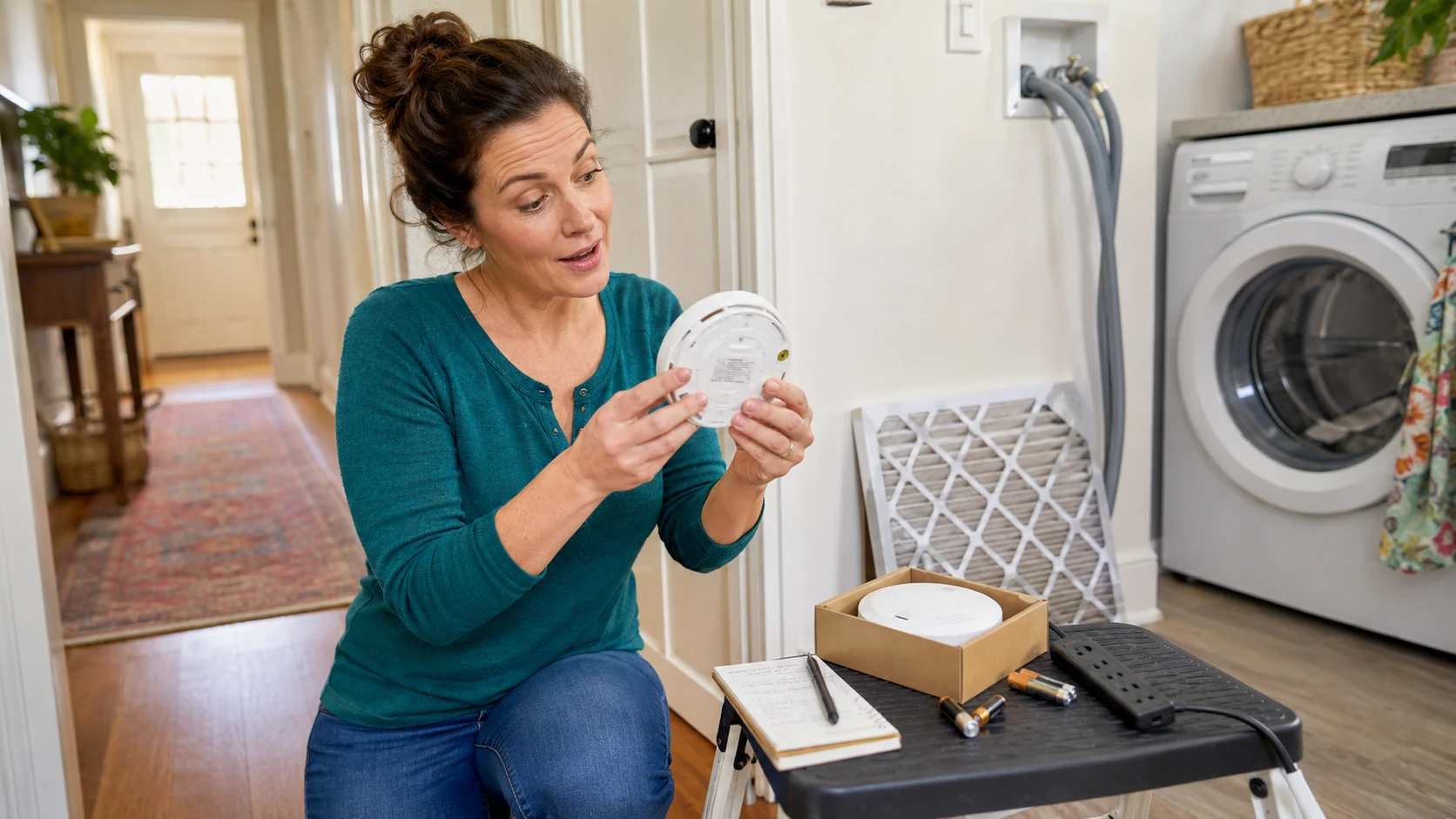
The U.S. Fire Administration says smoke alarms should be replaced when they are 10 years old and tested regularly. The manufacturing date is often printed on the back or base, which means checking it may require gently twisting the alarm off its mounting plate according to its instructions.
A successful test confirms that the alarm can sound; age guidance still matters. Replace an alarm sooner if it fails testing, is damaged, has been recalled, or the manufacturer instructs you to do so. Follow the model’s manual and local fire-safety guidance.
Official guidance: U.S. Fire Administration smoke-alarm guidance.
4. Carbon-monoxide alarms
Carbon-monoxide alarms do not all share one universal replacement age. The Consumer Product Safety Commission advises following the manufacturer’s instructions and notes that the recommended replacement age can be found in product literature or obtained from the manufacturer.
The test button checks circuitry and sound, not the sensor’s accuracy. Look for the model number, manufacturing date, end-of-life signal instructions, and replacement guidance on the alarm or in its manual.
Official guidance: CPSC carbon-monoxide alarm questions and answers.
5. Fire extinguishers
Fire extinguishers need inspection and maintenance, not a casual assumption that the red cylinder is immortal. NFPA guidance calls for regular visual inspection, including checking accessibility, pressure indication where provided, damage, corrosion, leakage, and whether the pin and seal remain intact.
Replacement or professional servicing depends on the extinguisher type, condition, label, and manufacturer instructions. Do not open, discharge, recharge, or pressure-test an extinguisher yourself unless you are properly trained and authorized.
Official guidance: NFPA guide to extinguisher inspection, testing, and maintenance.
6. Surge protectors and power strips
A power strip provides extra outlets. A surge protector also contains components intended to absorb or divert voltage spikes. Those protective components may be affected by major surges or accumulated smaller events, and some models provide a status light or replacement indicator.
There is no single replacement timeline that fits every surge protector. Follow the manufacturer’s guidance and replace devices that show damage, overheating, loose outlets, failed indicators, recall status, or other warning signs. Never daisy-chain strips or use one beyond its electrical rating.
CPSC has repeatedly warned about defective cords, strips, and surge protectors that can create fire and shock hazards. Check the CPSC recall listings for cables and surge protection.
7. Washing-machine supply hoses
Washing-machine hoses can look acceptable from the front while developing bulges, cracks, corrosion, stiffness, abrasion, or leakage near the connections or behind the appliance.
Inspect what you can see without moving or disconnecting equipment unsafely. Follow the washer and hose manufacturers’ inspection and replacement guidance. If connections are corroded, inaccessible, leaking, or difficult to shut off, use a qualified plumber or appliance professional.
This belongs on the same practical list as the small home repairs I no longer put off, because a small warning sign can become a very wet invoice.
8. Refrigerator and drinking-water filters
Water-filter cartridges have limited capacity. Their useful life varies with filter type, water quality, usage, certification, and model. EPA guidance emphasizes following manufacturer instructions for installation, use, maintenance, and cartridge replacement.
The indicator light is useful only when it has been reset correctly and the replacement filter matches the system. If the filter is used to reduce a particular contaminant, confirm that the replacement carries the appropriate certification for that purpose.
Official guidance: EPA guidance on filter selection, use, and replacement.
9. HVAC filters
HVAC filters are not all replaced on the same schedule. Filter type, household size, pets, dust, smoke, system runtime, and manufacturer requirements all matter. ENERGY STAR recommends checking filters regularly and replacing or cleaning them as needed.
Use condition and system guidance rather than treating one calendar interval as sacred. A heavily loaded filter can restrict airflow and make equipment work harder.
I once found three unopened replacement filters in a closet while the filter actually doing the work had apparently been elected to a lifetime appointment.
Official guidance: ENERGY STAR heating and cooling maintenance guidance.
10. Caulk, seals, and weatherstripping
Caulk and weatherstripping do not usually expire on a universal household schedule after installation. They should be inspected for gaps, separation, cracking, hardening, missing sections, drafts, daylight, moisture intrusion, or loss of compression.
Replace or repair them when condition and performance show they are no longer sealing properly. Use the correct material for the location, and do not seal over moisture, mold, damaged building materials, or combustion-ventilation problems.
Official guidance: Department of Energy guidance for finding air leaks.
11. Emergency batteries and stored supplies
Emergency kits can quietly become museums of dead batteries, expired food, outdated medications, and flashlights that have developed battery corrosion. Ready.gov recommends checking expiration dates and replacing expired supplies.
Review the kit on a recurring calendar date and rotate ordinary food and water before they become waste. Follow labels for medication, food, batteries, first-aid products, and other dated supplies.
Official guidance: Ready.gov emergency-kit guidance.
12. Nonstick cookware and food-storage containers
Cookware and food-storage items usually do not have one universal household expiration date. Condition and manufacturer instructions matter. Deep scratches, peeling coatings, warping, melted areas, persistent odors, cracks, damaged lids, or surfaces that can no longer be cleaned properly are reasons to stop and evaluate the item.
Do not keep using damaged cookware merely because the handle is still attached. Follow the manufacturer’s care and replacement instructions, and use utensils and heat settings appropriate for the product.
This is where checking which household things I may be replacing too soon becomes useful in both directions: some items deserve more life, while others deserve a closer inspection.
13. Extension cords and damaged electrical accessories
Extension cords are temporary wiring tools, not permanent substitutes for adequate outlets. Replace cords and accessories that are cracked, frayed, hot, loose, discolored, crushed, missing grounding features, or otherwise damaged.
Never repair a damaged cord with ordinary tape or hide it under rugs, doors, or furniture. Match the cord to the load and environment, and use products carrying the appropriate safety certification.
CPSC identifies faulty extension cords and power products as shock and fire hazards. Official reference: CPSC extension-cord safety information.
14. Where to find manufacturing dates and model information
Look on the back, underside, base, battery compartment, hose printing, filter frame, rating label, packaging, receipt, installation paperwork, or inside the manufacturer’s app. Date formats vary, and some manufacturers use lot or serial codes.
Photograph the label before reinstalling or putting the item back. That saves you from repeating the household ritual of balancing on a step stool while trying to read six-point gray text.
15. How to make a simple household replacement calendar
Create one record for each item that benefits from testing, maintenance, or age tracking. Include:
- item and location
- brand and model
- manufacture or installation date
- last inspection, service, or replacement date
- manufacturer guidance
- next check date
- estimated replacement cost
The system can be a phone note, spreadsheet, digital calendar, or paper binder. The best format is the one you will actually reopen.
Adding estimated costs also turns maintenance into one of the “unexpected” expenses worth planning for, rather than an annual surprise with excellent timing.
16. Items that should be checked by a qualified professional
Gas appliances, electrical panels, hardwired safety systems, pressurized equipment, structural components, roofs, chimneys, water heaters, and inaccessible plumbing may require trained inspection or service.
Do not dismantle equipment to satisfy curiosity. If you smell gas, see scorching, hear arcing, find active leakage, suspect carbon monoxide, or encounter another immediate hazard, leave the area as appropriate and contact emergency services, the utility, fire department, manufacturer, or a qualified professional.
For non-emergency work, I use the same questions from how I compare home-service estimates before agreeing to repairs or replacement.
17. The annual home-safety review I now do
Once a year, I walk through the house with the calendar and check alarms, extinguishers, visible cords, hoses, filters, emergency supplies, seals, and product labels. Monthly or more frequent tests still happen where official guidance requires them; the annual review is simply my broader inventory.
The goal is not to replace everything on a schedule invented by the internet. The goal is to know what you own, what protects the house, what guidance applies, and what deserves attention before failure makes the decision for you.
Faye’s rule: I replace by evidence, official guidance, and condition—not by panic and not by appearance alone.
The bottom line
Some household items truly expire. Others have a recommended service life, a test schedule, an inspection requirement, or a condition-based replacement point. Those categories should not be blended into one dramatic list of things supposedly plotting against the house.
The useful habit is simple: find the label, record the date, follow the manufacturer and official guidance, inspect what you can safely inspect, and call a qualified professional when the work is beyond ordinary household maintenance.
Which item in your home have you never checked for a manufacture date or replacement instruction? Mine was the smoke alarm, standing overhead for years with the confidence of someone who knew I would never ask for identification.
Official sources used
- U.S. Fire Administration: Smoke Alarms
- CPSC: Carbon Monoxide Questions and Answers
- NFPA: Fire Extinguisher Inspection, Testing, and Maintenance
- ENERGY STAR: Heating and Cooling Maintenance
- EPA: Water Filter Use and Replacement
- Department of Energy: Detecting Air Leaks
- Ready.gov: Build an Emergency Kit
- CPSC: Extension Cords