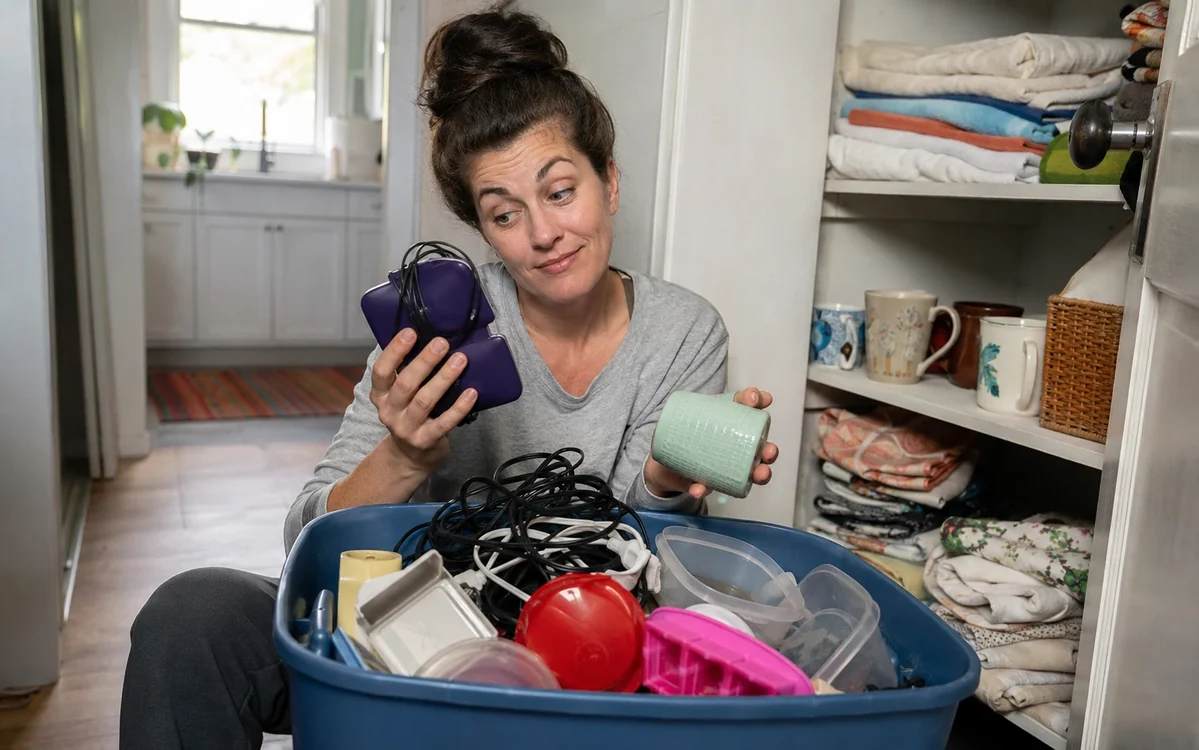
I used to think “just in case” was responsible. Practical, even. Keep the cord because it might belong to something. Keep the box because the thing was expensive. Keep the old towel because one day there may be a towel emergency, apparently.
Then I opened a drawer and found a cable I did not recognize, could not explain, and still felt nervous about throwing away. I treated it like evidence in a federal case. That was when I realized “just in case” had quietly become a storage strategy built on fear.
I still keep useful backups. I am not trying to live like a person who owns one spoon and calls it freedom. But I stopped keeping the things that were only stealing space, attention, and little bits of sanity.
Faye’s rule: If I do not know what it goes to, I do not get to keep it forever like a cursed family heirloom.
1. The cord drawer
The cord drawer was my first real test. Old charging cords, mystery adapters, cables from devices I no longer owned, and one black cord that could have powered either a printer or a submarine.
If I do not know what it goes to, I do not keep it forever. I give myself one quick chance to identify it. If nothing in the house needs it, it goes into e-waste instead of living rent-free in a drawer.
2. Boxes from expensive purchases
I used to keep boxes because the item felt important. Phone boxes, appliance boxes, small electronics boxes, the kind with thick cardboard that whispers, “I was expensive, please respect me.”
A box is not a warranty. Unless I am inside the return window, planning to resell the item soon, or truly need the box for storage, I do not keep it. The product can be valuable without its cardboard throne.
3. Clothes for a fantasy version of me
This category was not just clutter. It was emotional clutter with buttons. Clothes for a body I might have again, a job I no longer have, a lifestyle I apparently invented while standing under bad dressing-room lighting.
If clothing makes me feel bad every time I see it, it is not motivation. It is a tiny closet bully. I keep what fits my real life, not the imaginary version of me who attends garden parties and never spills coffee.
4. Extra mugs and water bottles
Mugs multiply. Water bottles do too. They arrive from gifts, events, trips, and optimistic health phases. Suddenly one person has enough drinkware for a conference.
I only need the ones I actually reach for. The rest were not sentimental. They were ceramic traffic. I kept favorites, donated the extras, and immediately made the cabinet less annoying.
5. Old towels that were not actually useful
I told myself old towels were useful for messes, pets, spills, and cleaning. Some were. Others were just stiff, sad fabric squares taking up space because I had confused “worn out” with “practical.”
Useful rags need a limit. I keep a small stack for real messes and let the rest go. There is no prize for maintaining a museum of former towels.
6. Manuals for things I can look up online
I used to keep appliance manuals in a folder like I was running a tiny administrative office for my toaster. Then I realized most manuals are online, searchable, and much easier to find than the one paper booklet hiding behind tax documents from three years ago.
If the manual is easy to find online, I do not keep the paper copy. The exception is anything with unusual parts, installation notes, or model-specific warranty details I may actually need.
Faye’s rule: A backup is useful only if I know what it is, where it lives, and when I would actually use it.
7. Broken things I was never going to fix
This was painful because broken things feel like unfinished business. A lamp that needs rewiring. A chair with a loose leg. A small appliance that “probably just needs one part,” said every liar in human history.
If I have not fixed it after months of seeing it, I am probably not fixing it. I either schedule the repair, find the part, or let the item go. “Someday” is not a repair plan.
8. Duplicate kitchen tools
I had duplicate peelers, spatulas, measuring spoons, bottle openers, and enough random utensils to make one drawer jam like it was protecting state secrets.
Duplicates only earn space if they are genuinely useful. Two spatulas make sense. Six nearly identical ones do not, unless I am opening a pancake truck without telling myself.
9. Random containers without lids
Few things create household nonsense faster than containers without lids and lids without containers. I used to keep them because surely the missing piece would appear. It rarely did. It was not a mystery. It was plastic grief.
If the container and lid cannot find each other, they are not storage. They are clutter shaped like potential.
10. Hobby supplies from abandoned phases
This one required honesty. I had supplies from hobbies I wanted to become the kind of person who did. Not hobbies I was actually doing. Big difference, tragically.
Supplies do not equal a hobby. If I still feel pulled toward it, I keep a small starter amount. If the supplies only make me feel guilty, they go to someone who might actually use them.
Faye’s rule: If keeping it makes me feel guilty every time I see it, that is not storage. That is emotional rent.
11. The few “just in case” items worth keeping
I did not throw away every backup. That would be silly, and also how you end up needing a flashlight during an outage and finding only personal growth.
Some just-in-case items are worth keeping because they solve predictable problems. I keep batteries, basic tools, a few cleaning rags, first-aid supplies, emergency candles or lights, and a small amount of backup household staples. The difference is that these have a clear purpose and a clear home.
The bottom line
The hardest part of letting go of “just in case” clutter is admitting that some of it was never practical. It was fear, guilt, optimism, or old money trying to justify itself from a closet shelf.
Now I keep fewer things, but the things I keep make more sense. They have a job, a place, or a real reason to stay. That one shift made my house easier to clean, easier to use, and less quietly irritating.
If you have a “just in case” category you finally stopped keeping, I want to hear it. Especially if it involves mystery cords, because apparently those things are the cockroaches of household clutter.
This connects closely with small home habits that make a house less chaotic. It also fits with household things I was replacing too soon, because the same small decisions tend to overlap in real life.