A water bill can rise for perfectly ordinary reasons. A longer billing period, hotter weather, houseguests, fresh landscaping, or a rate change can all move the total. It can also rise because a toilet has been quietly refilling for three weeks while looking innocent enough to testify in court.
When a bill suddenly jumps, I do not begin by assuming the house has a major leak. I begin by separating the price of water from the amount of water used, then work through the easiest explanations before moving toward hidden plumbing problems.
I learned this after blaming a mysterious increase on “probably the rates” and later discovering an irrigation emitter making a tiny private pond behind a shrub. The shrub was thriving. My budget was less enthusiastic.
Faye’s rule: I investigate the usage first, the bill second, and the plumbing one sensible step at a time.
I compare water use, not just the dollar total
The first thing I look for is the amount of water billed. Depending on the utility, that may appear in gallons, cubic feet, hundreds of cubic feet, or another unit. I compare it with the previous month and, when possible, the same season last year.
A higher total does not prove that the household used more water. Rates, fixed charges, sewer charges, taxes, and other fees may have changed even when usage stayed similar.
EPA WaterSense recommends looking at water use over time and notes that an unexplained increase can be a sign of a leak. Its guidance also explains that water bills vary in format and may include several separate charges.
Official guidance: EPA WaterSense: Understanding Your Water Bill.
I check the number of billing days
A bill covering thirty-five days will usually be higher than one covering twenty-eight days, even if daily use stayed nearly identical. Meter-reading schedules, weekends, holidays, estimated readings, or utility operations can change the length of a billing cycle.
I compare average daily use when the bill provides it. When it does not, I divide the usage by the number of billing days to get a rough comparison. This is household arithmetic, not forensic accounting, but it can stop a longer billing cycle from masquerading as a plumbing emergency.
I look for estimated readings and rate changes
Some bills identify whether the meter reading was actual or estimated. An estimated bill may later be corrected when the utility obtains an actual reading. A meter replacement or account adjustment may also affect what appears on the bill.
The utility should explain its own bill better than I can guess at it. If the units, readings, dates, or fees are unclear, I call the number printed on the official bill or use the utility’s verified website.
I ask whether the reading was estimated, whether rates or fees changed, whether the billing period was unusual, and whether the utility sees continuous-use or leak alerts on the account. Policies and available data vary by utility.
Then I ask what changed at home
Before testing toilets and crawling under sinks, I make a short list of unusual water use during the billing period. That may include guests, extra laundry, deep cleaning, filling a pool, watering new plants, pressure-washing, car washing, construction, an evaporative cooler, or a child discovering that the hose is apparently a lifestyle.
Ordinary use can explain a surprising bill when several small changes happen together. Outdoor watering is especially easy to underestimate because it runs out of sight and often on a schedule.
The toilet test comes early
A toilet can leak from the tank into the bowl without leaving water on the floor. Clues include periodic refilling, a faint running sound, movement in the bowl, or a handle that needs jiggling.
A toilet does not need to look broken to waste water. EPA WaterSense recommends placing a few drops of food coloring in the toilet tank, waiting about ten minutes without flushing, and checking whether color appears in the bowl. Flush immediately afterward to avoid staining.
I follow the toilet manufacturer’s instructions and avoid tablets or chemicals that the manufacturer warns could damage tank components.
Official guidance: EPA WaterSense: Fix a Leak Week.
Faye’s rule: The quietest fixture in the house can still be the loudest item on the bill.
I inspect visible fixtures and connections
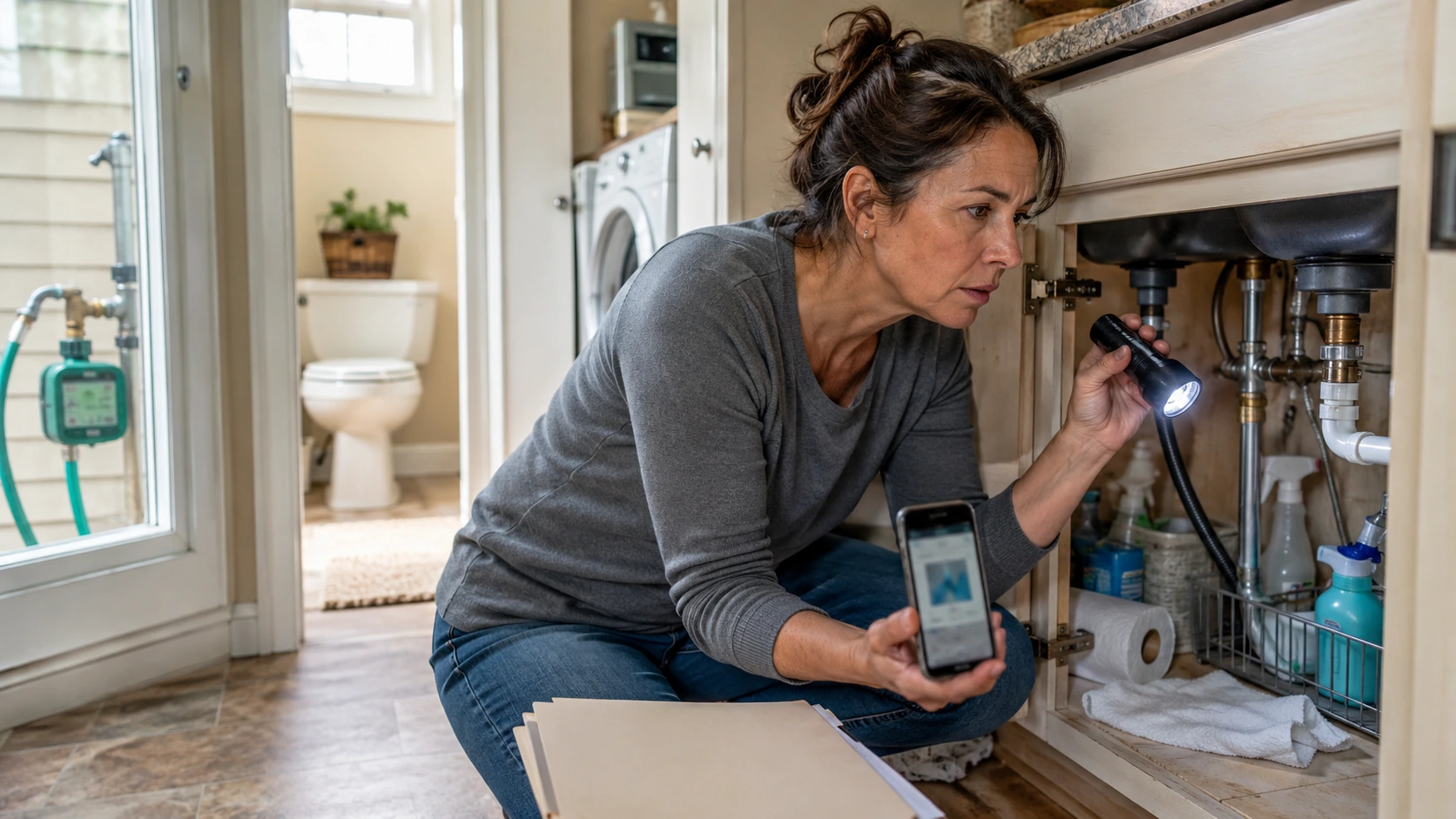
I walk through the house with a flashlight and a dry paper towel. I look under sinks, around toilet bases, near shower and tub controls, beneath dishwasher edges, behind accessible appliance panels only when the manufacturer permits it, and around visible pipe fittings.
Moisture is easier to confirm with a dry towel than with a suspicious fingertip. I look for beads of water, mineral deposits, staining, warped cabinet material, corrosion, musty odors, or damp flooring.
I do not tighten unfamiliar fittings aggressively. A small visible seep can become a much larger problem when an old connection is disturbed without the right tools or shutoff plan.
I check the washing machine and dishwasher
For the washing machine, I inspect accessible supply hoses, hose connections, the drain area, and the floor behind or beside the machine. Bulging, cracking, corrosion, dampness, or an active drip deserves prompt attention.
For the dishwasher, I look for water beneath the front edge, moisture inside the sink cabinet where the supply and drain lines may connect, and signs of repeated dampness around nearby flooring or cabinets.
Appliance connections can leak only during part of a cycle. A dry floor in the morning does not rule out a problem that appears during filling or draining. I observe from a safe distance and stop the appliance if I see active leakage or electrical risk.
This is one reason I do not delay the warning signs in the small home repairs I handle early.
I do not forget the refrigerator water line
Refrigerator supply lines and connections can leak slowly behind the appliance or inside a nearby cabinet. I check accessible areas for dampness, staining, softened flooring, or a change in the ice maker or dispenser behavior.
I do not pull a heavy refrigerator across finished flooring just to satisfy my curiosity. If the line is inaccessible, the appliance is difficult to move safely, or there are signs of hidden moisture, I call a qualified appliance technician or plumber.
I check the water heater area
I look around the water heater for active dripping, water in the drain pan, corrosion, staining, dampness, or discharge from a pipe. Some water heaters and plumbing systems may release small amounts of water under specific conditions, but the correct interpretation depends on the equipment and installation.
An active tank leak, gas odor, combustion concern, electrical problem, or hot-water discharge is not a do-it-yourself billing investigation. I stop, keep people away from the hazard, and contact the appropriate qualified professional or emergency service.
I listen for the water softener or treatment equipment
A water softener, filtration system, reverse-osmosis unit, humidifier, or other water-using equipment may cycle, flush, regenerate, or drain. A settings change, stuck component, repeated cycling, or installation problem can increase use.
I check the current settings and manufacturer instructions before changing anything. If the equipment seems to run unusually often, I document the time and frequency and contact the installer or manufacturer-authorized service provider.
Outdoor water use deserves its own inspection
I walk irrigation zones while they operate, if it is safe and permitted, and look for broken emitters, damaged sprinkler heads, overspray, pooling, unusually green patches, sunken areas, stuck valves, and water running into the street.
A small irrigation problem can run for hours because the system is designed to operate unattended. I also check hose bibs, timers, pool auto-fill equipment, and any outdoor water features.
Local watering rules, leak programs, rebates, and irrigation guidance vary, so I use my utility or municipality’s official instructions rather than assuming another city’s rules apply.
I use the meter only according to utility instructions
EPA WaterSense suggests checking the water meter before and after a period when no water is being used. If the reading changes, that may indicate water is moving somewhere in the system.
I treat the meter as utility equipment, not a puzzle box. I do not break seals, open utility-owned components, remove covers I am not authorized to touch, reach into flooded meter boxes, enter traffic areas unsafely, or dig around service lines.
Before a meter check, I turn off known water uses without shutting off systems that must remain operating for safety. I make sure toilets are not refilling, irrigation is off, appliances are not cycling, and nobody uses water during the observation period. Then I follow the local utility’s published process because meter types differ.
Unexplained meter movement narrows the problem
If the meter or utility data shows water use while everything known is off, I document the readings and time. The issue could still be inside the house, in irrigation, in treatment equipment, or along the service line.
Meter movement is evidence of water use, not a map to the leak. Locating underground or concealed leaks may require a licensed plumber, leak-detection specialist, irrigation professional, or the utility, depending on where responsibility begins and ends.
I do not dig for a service line or assume the utility owns every pipe outside the house. Ownership and repair responsibility vary by location.
I document before the evidence disappears
I photograph the bill, meter reading if safely visible, wet areas, stains, damaged materials, and any fixture that seems involved. I note dates, times, appliance cycles, irrigation schedules, and who I contacted.
A clear record is useful for the utility, plumber, insurer, landlord, or repair company. It also prevents me from trying to remember whether the meter changed by one digit or whether I merely stared at it with exceptional intensity.
The simple recordkeeping system in the home records I wish I had kept sooner works well for bills, repair photos, invoices, and model information.
I know when to stop investigating
I call for qualified help when I find active leaking that I cannot isolate safely, ceiling or wall moisture, damaged flooring, a warm or wet slab area, unexplained low pressure, repeated meter movement, sewer odors, electrical exposure, mold-like growth, or signs that water has reached structural materials.
Stopping water damage quickly matters more than completing the checklist. If safe, I use a known fixture or appliance shutoff. I do not operate an unfamiliar main valve during an emergency unless I understand the system and can do so safely.
When hiring help, I use the same scope and warranty questions from how I compare home-service estimates.
If the bill still does not make sense
I contact the water utility with the bill, account details, meter readings, dates, and the checks I completed. I ask for an explanation of the usage, rate structure, reading type, billing-period length, meter history, and any available leak-alert information.
Leak-adjustment and billing-dispute policies are local. I do not assume a repair receipt guarantees a credit or that every utility handles disputed readings the same way.
If a company does not resolve a service complaint, USAGov recommends contacting the company first, keeping records, and then using the appropriate state or local consumer-protection channel when necessary.
Official resources: USAGov: Complaints About Products and Services and State Consumer Protection Offices.
My compact water-bill checklist
- Compare usage: Check gallons or billing units, not only dollars.
- Count billing days: Compare daily use when cycles differ.
- Check the reading: Actual, estimated, corrected, or meter replacement?
- Review rates: Look for changed fees, sewer charges, or rate tiers.
- List unusual use: Guests, laundry, cleaning, landscaping, pool, or cooling equipment.
- Test toilets: Follow the EPA dye-test instructions and flush afterward.
- Inspect visible plumbing: Faucets, under-sink fittings, toilets, tubs, and showers.
- Check appliances: Washer, dishwasher, refrigerator line, and water heater.
- Check treatment equipment: Softener, filters, humidifier, or reverse-osmosis system.
- Inspect outdoors: Irrigation, hose bibs, auto-fill systems, and wet ground.
- Observe the meter safely: Use only the local utility’s instructions.
- Document: Bills, readings, photos, dates, damage, and calls.
- Escalate: Call qualified help for hidden, active, electrical, structural, or service-line concerns.
Faye’s rule: I do the simple checks myself, but I do not turn a high bill into a larger repair by dismantling something I do not understand.
The bottom line
A sudden water-bill increase is a clue, not a diagnosis. The cause may be a rate change, a longer billing period, ordinary seasonal use, an estimated reading, a quietly leaking toilet, an appliance connection, irrigation, treatment equipment, or a concealed plumbing problem.
The useful approach is to compare actual usage, rule out billing explanations, inspect the common household sources, observe the meter only as the utility instructs, and document what you find.
Most importantly, I do not let embarrassment delay the phone call. Plumbers have seen worse, utilities have heard stranger questions, and the toilet is not going to confess voluntarily.