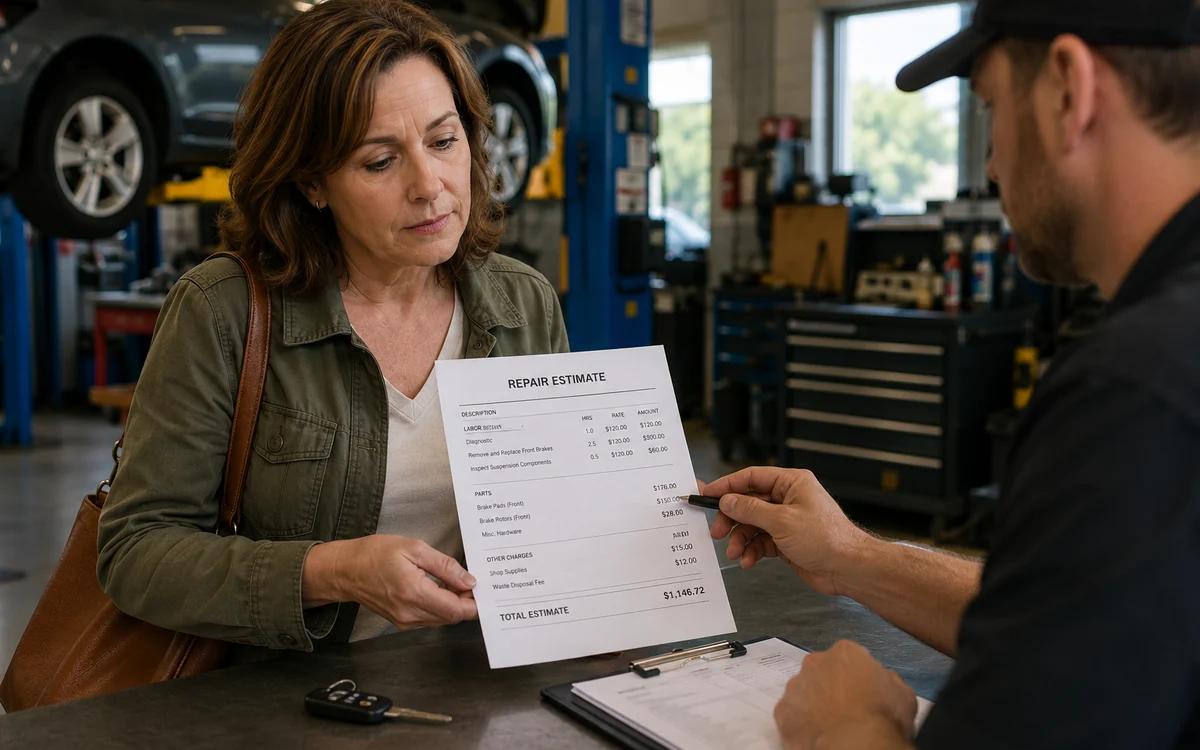
An auto repair estimate can look simple until you try to understand what you are actually approving. There is a labor line, a parts line, maybe a diagnostic fee, maybe shop supplies, and then a total that arrives with the confidence of a person who has never had to explain why a plastic clip costs forty-two dollars.
I do not expect every driver to become a mechanic. I do expect a repair estimate to answer the basic household question: what am I paying for, what problem does it solve, and what happens if I wait?
The total price is only useful after the estimate explains the work. A cheaper quote can leave out necessary testing. A higher quote can include better parts, more labor, or work you do not need yet. The job is not to argue every line down. The job is to understand which lines deserve a yes, a question, or a second opinion.
Faye’s rule: I do not approve car repairs from the final number alone. I want the problem, the part, the labor, and the urgency explained in plain English.
Start by separating diagnosis from repair
A diagnostic fee pays for the shop to identify the problem. A repair charge pays to fix it. Those are related, but they are not the same thing.
A good estimate should tell you whether the shop has confirmed the problem or is still testing. “Check engine light” is not a repair. “Replace oxygen sensor after code scan, voltage test, and inspection of wiring” is much closer to a real explanation.
Diagnostic charges can be legitimate, especially when the issue requires scanning, test-driving, disassembly, or electrical tracing. I get cautious when a shop wants me to approve a major repair before it can explain how it ruled out cheaper causes.
Labor rate and labor hours are different numbers
The hourly labor rate is what the shop charges per labor hour. The labor hours are the time assigned to the job. A repair can be expensive because the rate is high, because the job takes many billable hours, or because both things decided to ruin your afternoon together.
Ask for the labor rate and the labor hours separately. If an estimate says $600 in labor, that could mean four hours at $150, three hours at $200, or some bundled shop pricing that needs explanation.
Many shops use estimating guides or flat-rate systems rather than billing exactly by stopwatch. That does not automatically make the estimate unfair. It does mean you should know whether you are being charged for book time, actual time, or a packaged job price.
Parts choices can change the total quickly
Parts are not all the same. An estimate may use original equipment manufacturer parts, aftermarket parts, remanufactured parts, rebuilt parts, or used parts. Each choice can affect price, fit, warranty, availability, and expected life.
I ask what type of part is being quoted and who warranties it. The cheapest part is not always the smartest part, especially when replacing it again would mean paying labor twice. On the other hand, the most expensive option is not automatically necessary for every older vehicle.
This is the same kind of decision I use when I ask whether I am replacing household things too soon. The answer depends on age, risk, expected use, and whether the repair actually buys more useful life.
Shop supplies and disposal fees should be reasonable
Some estimates include shop supplies, environmental fees, hazardous-waste disposal, brake cleaner, rags, clips, hardware, or fluid handling. These small lines are not automatically suspicious. Shops really do use materials that do not fit neatly into one named part.
The question is whether the fee is clear, proportionate, and connected to the work. A small disposal or supply charge on a brake job may be normal. A vague fee that keeps growing deserves a question.
Ask what the fee covers and whether it is a flat shop charge, a percentage, or tied to the specific repair. If the answer sounds like mist wearing a name badge, ask again.
Recommended work is not the same as urgent work
Repair shops often list several items at once. Some may be urgent, some may be maintenance, and some may be “watch this soon.” The estimate should not make all of them feel equally desperate.
Ask the shop to divide the work into safety-critical, reliability-related, maintenance, and optional items. Brakes grinding metal-on-metal are not in the same category as a cabin air filter that looks mildly offended.
This is where a written priority list matters. If you cannot afford everything at once, you need to know what protects safety, what prevents more damage, and what can wait until the next paycheck without turning the car into driveway sculpture.
Faye’s rule: When a repair list gets long, I ask what should be done today, what can wait 30 days, and what can be monitored.
Check whether a warranty, service contract, or recall applies
Before approving a repair, check whether the issue could be covered by a manufacturer warranty, extended service contract, parts warranty, previous repair warranty, or safety recall.
The National Highway Traffic Safety Administration recall lookup lets you search by VIN for unrepaired safety recalls. A recall is not the answer to every repair problem, but it is worth checking before paying out of pocket for a known safety issue.
Do not assume the repair shop has checked every possible coverage path for you. A good shop may help, but the financial incentive is not always aligned with finding someone else to pay the invoice.
Ask what happens if the repair does not solve the problem
Some repairs are straightforward. Others are educated steps in a diagnostic chain. That is common with intermittent electrical issues, warning lights, drivability problems, leaks, noises, and older vehicles with more than one tired part competing for attention.
Before approving the work, ask what the shop expects the repair to fix and what happens if the symptom remains. Will the diagnostic fee apply to the repair? Will the replaced part be warrantied? Would another diagnosis be charged separately?
This is not about demanding a magic guarantee on a complicated machine. It is about knowing whether the shop is making a confirmed repair or taking the next most likely step.
Compare estimates by scope, not just price
Two auto estimates may use different parts, labor assumptions, warranty terms, diagnostic steps, and included services. One may include alignment after suspension work while another leaves it out. One may quote pads only while another includes rotors and hardware. One may include programming. Another may mention it later, because apparently surprise fees needed a cousin.
Put the estimates side by side and compare the promised work line by line. This is the same basic habit I use when comparing home-service estimates before saying yes. Different words can mean different jobs.
If one quote is much lower, ask what is excluded. If one quote is much higher, ask what is included that the other estimate did not mention.
When a second opinion is worth it
A second opinion is especially useful when the repair is expensive, the explanation is vague, the car still drives safely, the estimate includes several unrelated systems, or the shop pressures you to approve everything immediately.
I do not get a second opinion to annoy a shop. I get one when the money or risk justifies it. For a small, clear repair, dragging the car across town may waste more time than it saves. For a large repair, a second qualified look can protect the budget.
If the vehicle is unsafe to drive, ask whether it can be towed or whether the shop can document the issue clearly enough for another mechanic to review. Safety beats thrift. Annoying, but true.
How to ask better questions without starting a fight
Most shops will respond better to clear questions than accusations. I avoid “Are you ripping me off?” even when my bank account is making that face.
Try questions like these:
- What problem did you confirm?
- How many labor hours are included?
- What type of parts are being quoted?
- Which items are urgent and which can wait?
- What fees are included besides parts and labor?
- What warranty applies to the parts and labor?
- What happens if this repair does not fix the symptom?
A trustworthy estimate should get clearer when you ask reasonable questions. If the explanation becomes more confusing, more urgent, and more expensive every time you pause, that tells you something.
Keep the paperwork after the repair
Save the estimate, final invoice, warranty terms, diagnostic notes, and any photos or inspection report. You may need them for a later warranty claim, resale records, insurance, taxes for a business vehicle, or a complaint.
The Federal Trade Commission’s auto repair guidance recommends understanding shop policies, asking about warranties, and keeping written records. The boring paper trail is not glamorous. It is also the thing everyone wishes they had when something goes sideways.
I keep car repair records the same way I keep important home records I wish I had organized sooner. Future-you deserves evidence, not a vague memory that the guy at the counter said something reassuring.
Faye’s rule: A final invoice should match the work you approved, or clearly explain why the work changed.
If something feels wrong after the repair
Start with the shop. Explain the problem calmly, show the paperwork, and ask what they can inspect or correct under the repair warranty. If the issue is a misunderstanding, this gives the shop a chance to fix it.
If the shop will not respond, review your state or local options. Consumer complaint paths vary, but USAGov’s complaint resources can help point you toward general product and service complaint steps.
Do not wait until the details are fuzzy. Write down dates, names, symptoms, promised fixes, and what happened after the repair. A messy timeline weakens even a valid complaint.
The bottom line
An auto repair estimate is not just a price. It is a decision document. It should explain the problem, the parts, the labor, the fees, the urgency, the warranty, and what risk you are taking if you wait.
The goal is not to beat every shop down to the lowest possible number. Good mechanics deserve to be paid for skilled work. The goal is to make sure the invoice describes work your household actually needs, at a price you understand, with enough documentation to protect you later.
What line item on a repair estimate has confused you most? Labor hours, diagnostic fees, and “shop supplies” seem to compete for the title every year.
This also connects with unexpected expenses worth saving for and questions to ask before paying for extended coverage, because car repairs have a special talent for turning “I’ll deal with that later” into a very current problem.