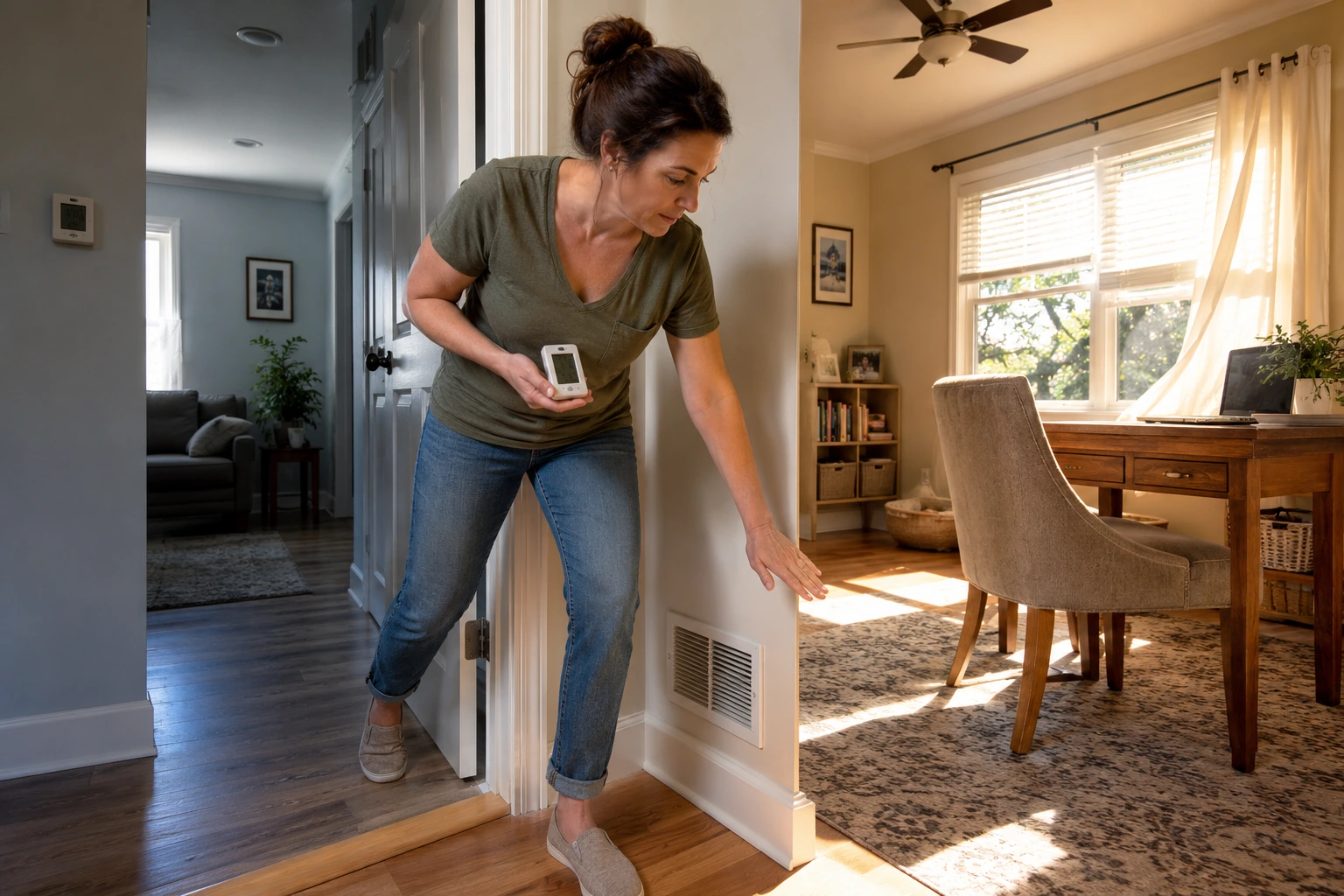
Every house seems to have one room with its own private climate policy. The hallway feels fine, the thermostat looks perfectly reasonable, and then one bedroom is warm enough to proof bread while another requires socks in July.
That difference does not automatically mean the heating and cooling system is failing. A room can feel hotter, colder, stuffier, or draftier because of several small conditions working together: sun on the windows, an exterior wall, a closed door, a blocked register, a long duct run, humid air, or a thermostat located somewhere that lives a much easier life.
I learned to stop asking only, “What does the thermostat say?” and start asking, “What is different about this room, at this time, under these conditions?” That question usually produces better clues than marching to the thermostat and changing the whole house for one rebellious corner.
Temperature and comfort are not the same thing
A thermometer measures air temperature, but your body experiences more than air. Comfort is influenced by humidity, airflow, drafts, clothing, activity, and the temperature of nearby surfaces.
A room with a large sun-warmed window may feel hot even when its air temperature is close to the hallway. The glass, wall, ceiling, and furniture can absorb and radiate heat toward the room. In winter, a cold window or exterior wall can make the same air temperature feel less comfortable because your body exchanges heat with those colder surfaces.
Air movement changes the experience too. A ceiling fan can make people feel cooler by moving air across the skin without lowering the room’s actual temperature. The U.S. Department of Energy explains that fans cool people through a wind-chill effect rather than cooling the room itself.
Humidity adds another layer. Higher humidity can make warm air feel more oppressive because perspiration evaporates less readily. Very dry air can feel uncomfortable in other ways. EPA guidance recommends measuring humidity rather than guessing and notes that moisture control matters for comfort and indoor air quality.
Start by finding the pattern
The timing of the problem is often more useful than one isolated reading. I compare the room at roughly the same times for several days instead of taking one measurement and declaring the case solved.
I note:
- the room temperature and humidity;
- the nearby hallway or adjacent-room readings;
- outdoor weather and sun conditions;
- whether the room door is open or closed;
- whether the heating or cooling system is running;
- whether blinds, curtains, ceiling fans, computers, or other heat-producing items are in use;
- how the room feels compared with what the instruments show.
If the room becomes uncomfortable only on sunny afternoons, the windows and orientation deserve attention. If it changes mainly when the door is closed, the return-air path may matter. If several rooms have weak airflow, the issue may be broader than one piece of furniture sitting over one register.
Sun exposure and room location can create their own microclimate
Where a room sits in the house can change its heating and cooling load dramatically. A room with several exterior walls, a large window, a high ceiling, an attic above it, or a garage below it faces different conditions from an interior hallway.
East-facing windows usually receive stronger morning sun. West-facing windows often collect afternoon heat when outdoor temperatures are already high. DOE guidance on skylights similarly notes that orientation changes when solar heat gain occurs, with west-facing glazing tending to bring afternoon sunlight and heat.
Rooms under an attic or at the edge of the house may also expose more surface area to outdoor conditions. ENERGY STAR lists drafty rooms, hot or cold ceilings and walls, and uneven room temperatures among common signs that air sealing or insulation may deserve evaluation.
That does not prove the insulation is defective. It simply gives me a sensible place to look. I compare the room on cloudy and sunny days, touch interior surfaces cautiously, and observe whether curtains or blinds change the pattern.
Supply vents, returns, and closed doors all matter
Conditioned air has to reach the room and then find a path back. DOE describes central air systems as using supply ducts and registers to deliver conditioned air and return ducts or registers to pull air back toward the air handler.
A supply register can be open but still ineffective if a bed, dresser, rug, curtain, or stack of boxes disrupts the airflow. Dust on an accessible grille may also reveal that it has not been checked in a while. I clear ordinary obstructions and clean only the parts intended for routine homeowner access.
Then I test the door. A room that changes noticeably with the door closed may not have an easy return-air pathway. Some homes use dedicated return vents; others rely on door undercuts, transfer grilles, or other designed paths. I do not cut doors or modify ducts based on an internet hunch, but the open-door versus closed-door comparison is useful information for a qualified professional.
I also resist the popular temptation to close a collection of vents elsewhere to “push” more air into the problem room. Systems differ, and restricting airflow can create pressure or performance problems. A reversible furniture move is an experiment. Redesigning the duct system with register levers is amateur theater.
Windows, drafts, and surface temperatures can fool the thermostat
A draft is moving air; a cold surface is not automatically a draft. I check windows and exterior doors for obvious air movement, damaged weatherstripping, gaps, condensation, or curtains that interfere with vents.
DOE says air sealing can improve comfort by reducing unwanted air leakage, but the correct product and method depend on the location. Simple weatherstripping may be appropriate for an operable door or window. Other leakage paths, especially those near combustion equipment, electrical components, attics, or ducts, may require professional judgment.
Heavy curtains can reduce discomfort near a window, but they can also trap air or cover a register. Blinds can reduce solar gain when the sun is the problem. I test one change at a time so I know whether it helped.
Persistent condensation, staining, soft materials, or musty odors are not just comfort quirks. EPA advises addressing moisture and water problems because lingering dampness can damage materials and support mold growth. I treat those signs as a separate problem worthy of prompt attention.
Humidity and stuffiness deserve their own measurement
“Stuffiness” is not a precise diagnosis. It may describe high humidity, low air movement, heat from occupants or electronics, odors, insufficient ventilation, or a combination of those things.
A small thermometer-hygrometer can help separate temperature from humidity. I place it away from direct sun, vents, exterior doors, lamps, and electronics, then compare readings under similar conditions. EPA’s current indoor-air guidance recommends using a humidity gauge and generally keeping indoor relative humidity in a moderate range, while recognizing that climate and conditions vary.
If humidity is elevated in one room, I look for ordinary sources: an attached bathroom, damp laundry, many plants, an aquarium, cooking, a poorly vented appliance, or a closed room that receives little air circulation. Persistent moisture, visible growth, recurring condensation, or odors call for more than simply adding a fan.
The thermostat may be accurately describing the wrong part of the house
A thermostat controls from the conditions where it is located, not from every room simultaneously. A thermostat in a shaded central hallway may be satisfied while a west-facing bedroom continues absorbing afternoon heat. A thermostat near a draft, supply register, sunny window, kitchen, or heat-producing device may also experience conditions that do not represent the rest of the home.
I do not relocate or rewire a thermostat as a casual experiment. Instead, I compare the thermostat area with the problem room and record the difference. Some systems support approved remote sensors, zoning, or balancing adjustments, but compatibility and placement should follow equipment instructions and professional guidance.
This is one reason a room log helps. “The bedroom is always hot” is vague. “The bedroom is five degrees warmer than the hall from 3 to 6 p.m. on sunny days, while the door position makes little difference” is actionable.
Furniture and curtains can create surprisingly effective roadblocks
The easiest airflow problem to fix is the one caused by ordinary household placement. I check whether a sofa blocks a low wall return, a bed covers a floor register, a curtain hangs over a vent, or a desk traps warm equipment exhaust in the room.
Electronics can matter more than expected in a small room. Computers, monitors, televisions, gaming equipment, printers, lamps, and chargers all release heat. Several people in a closed room add heat and moisture too. A home office that feels fine before work and stuffy after several hours may be telling a very ordinary story.
I move obstacles carefully, maintain required clearances around equipment, and observe the result. I do not place fabrics near heaters or improvise a vent extension with cardboard, foil, or optimism.
Simple tests that narrow the cause
Good tests are low-risk, reversible, and performed one at a time. I use a short list:
- Compare the room and hallway at the same times for several days.
- Test the room with the interior door open, then closed.
- Confirm accessible registers are open and unobstructed.
- Move furniture, rugs, and curtains away from airflow paths.
- Close blinds during strong sun, then compare the result.
- Turn off unnecessary electronics and observe whether heat buildup changes.
- Use the ceiling fan according to its manufacturer’s instructions and DOE guidance, remembering that it affects people more than room temperature.
- Review the HVAC filter and equipment instructions rather than relying on a universal replacement schedule.
I write down what changed. Testing three things at once may improve the room, but it does not tell me which change mattered.
Mistakes that can make airflow or safety worse
Not every intuitive fix is harmless. I avoid closing many supply vents, blocking return grilles, dismantling equipment, cutting ducts, entering unsafe attics or crawl spaces, or opening electrical panels.
I also do not use unvented combustion equipment indoors to compensate for a cold room. CPSC warns that fuel-burning heaters and other combustion products can create carbon-monoxide hazards when used or vented improperly. Carbon monoxide is colorless and odorless, so a person cannot confirm safety by smell or appearance.
Fuel-burning equipment, flues, vents, combustion-air openings, and carbon-monoxide alarms should be handled according to manufacturer instructions and applicable safety guidance. Burning odors, soot, alarm activation, headaches, nausea, dizziness, or symptoms that improve after leaving the area deserve immediate attention, not another round of thermostat adjustments.
When professional evaluation makes sense
A comfort investigation should stop where safety or specialized diagnosis begins. I call an appropriate qualified professional when I see or experience:
- persistent condensation or visible moisture damage;
- suspected mold or recurring musty odors;
- burning odors, soot, or carbon-monoxide concerns;
- unusual equipment noises or repeated breaker trips;
- weak airflow in several rooms;
- large unexplained temperature differences that persist;
- accessible ductwork that appears disconnected or damaged;
- a room that cannot maintain a safe condition;
- symptoms that occur in the room and improve after leaving it.
A professional may evaluate airflow, pressure, duct condition, insulation, air leakage, equipment operation, room load, or moisture sources. That is different from assuming the answer is automatically “buy a new system.” The same comparison discipline I use in The Home Services I Compare Before I Ever Say Yes still applies: understand the finding, the proposed remedy, and what evidence supports it.
A simple room-comfort observation log
A short log turns a vague complaint into a useful pattern. For three to seven days, record:
- date and time;
- outdoor conditions;
- room temperature and humidity;
- hallway or comparison-room readings;
- sun on the window or exterior wall;
- door open or closed;
- HVAC running or off;
- fan, curtains, blinds, and electronics in use;
- airflow at the register: strong, moderate, weak, or absent;
- how the room actually felt.
Keep the readings in one place. The recordkeeping habit from The Home Records I Wish I Had Kept Sooner works here too: a dated note is far more useful than trying to remember whether the room was worse last Tuesday or during the previous season.
Room-comfort checklist
- Compare room and hallway readings under similar conditions.
- Note whether the issue changes by time, season, weather, or sun exposure.
- Test the room with the door open and closed.
- Confirm supply and return grilles are unobstructed.
- Move furniture, rugs, and curtains away from airflow paths.
- Check accessible windows and doors for obvious gaps or damaged seals.
- Observe exterior walls, ceilings, and windows for unusual warmth, cold, or condensation.
- Measure humidity rather than labeling the room “stuffy.”
- Note electronics, appliances, and occupancy that add heat.
- Review filter, thermostat, and fan instructions for the actual equipment.
- Change one reversible factor at a time.
- Document moisture, odor, electrical, combustion, or system-wide warning signs.
Practical changes to test today
The first useful changes usually cost nothing. Clear the vent, open the door, adjust the blinds, turn off unnecessary electronics, and compare conditions at the same time tomorrow. Check whether the ceiling fan is operating in the intended direction for the season and follow its instructions.
Then review the system’s filter guidance and inspect only what is intended for routine access. If a room remains consistently uncomfortable, the notes help distinguish a window-and-sun problem from a door-and-return problem, a moisture problem, or a system-wide airflow concern.
The bottom line
One uncomfortable room is not a diagnosis. It is a clue. Sun exposure, exterior surfaces, door position, return-air pathways, vent obstructions, humidity, thermostat location, and ordinary household heat can combine in ways that make one room behave differently from the rest.
The goal is not to become an HVAC technician. It is to collect enough reliable observations to make the next step sensible. Sometimes the answer is moving a chair or closing the blinds. Sometimes it is an air-sealing, insulation, duct, moisture, or equipment issue that deserves professional evaluation. The difference becomes clearer when I compare conditions instead of arguing with the thermostat.
Related Reading
- The Repair-or-Replace Math I Use Before Buying a New Appliance
- What I Check When the Water Bill Suddenly Jumps
- The Small Home Repairs I Don’t Put Off Anymore
Official Sources Used
- U.S. Department of Energy: Central Air Conditioning
- U.S. Department of Energy: Air Sealing Your Home
- U.S. Department of Energy: Fans for Cooling
- ENERGY STAR: Heat and Cool Efficiently
- ENERGY STAR: Attic Insulation Project
- U.S. Environmental Protection Agency: Care for Your Air
- U.S. Environmental Protection Agency: A Brief Guide to Mold, Moisture and Your Home
- U.S. Consumer Product Safety Commission: Carbon Monoxide Information Center