A storage unit can be wonderfully useful when life temporarily produces more belongings than walls. A move, renovation, estate, deployment, or gap between homes can make rented space the sensible option.
The trouble begins when “just for three months” quietly celebrates its second birthday. The introductory price has changed, the boxes have become mysterious, and I am paying every month to avoid deciding what is inside them.
I once priced a unit by looking at the advertised rent and mentally adding almost nothing. The actual decision included a lock, an administration charge, insurance, access restrictions, and a move-out notice rule. Humans apparently decided closets needed contracts.
Faye’s rule: I rent storage for a defined problem, not as a permanent pause button.
I decide whether the storage need is truly temporary
Storage can be practical during a move, home repairs, downsizing, estate administration, military deployment, temporary work relocation, combining households, seasonal storage, or a short gap between homes. It can also postpone a decision while charging rent for the privilege.
Before comparing facilities, I write down the reason for the unit and the date I expect to leave. I estimate the total cost through that date, not merely the first month. If I cannot name an exit condition, I may be creating an open-ended household bill.
For belongings kept from habit rather than need, I revisit the things I stopped keeping “just in case”. That article is about deciding what deserves space; this one is about deciding whether rented space deserves continued payment.
I compare the kind of storage, not just the unit number
Indoor hallway units, outdoor-access units, drive-up spaces, portable containers, warehouse-style storage, and vehicle storage solve different problems. Covered and uncovered vehicle storage also differ from enclosed storage. Some rentals are month-to-month; others use a fixed term or automatically renew.
Convenience, protection, and price change with the format. A drive-up unit may simplify heavy loading but expose the doorway to more dust and weather. An indoor unit may offer better hallway protection but require elevators, carts, and limited loading routes. Portable containers add transportation and placement questions.
I ask who controls transportation, where the property will be stored, whether the unit can be relocated, and which contract applies during transit and storage.
I measure usable space instead of trusting a size label
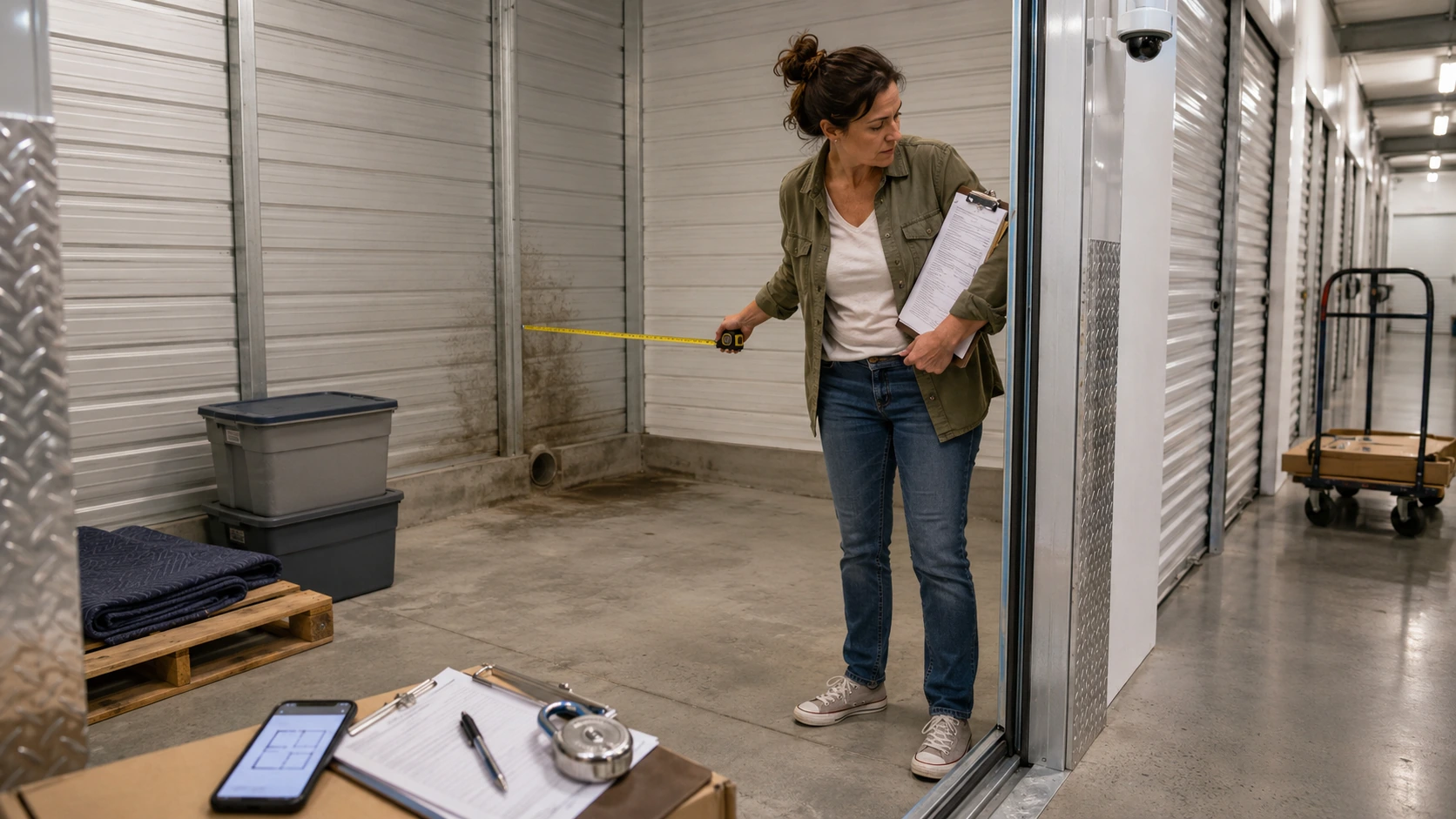
A listed unit size is only useful when the doorway, ceiling, columns, wall intrusions, and access route cooperate. I measure the unit, door opening, elevator, hallway turns, and loading area when large furniture is involved.
Nominal dimensions are not always usable dimensions. I also check ceiling height, sprinkler clearance rules, pallets, shelves, and whether doors roll inward or reduce usable space.
I sketch the floor plan and place the largest items first. Paying for a larger unit can be cheaper than damaging furniture while forcing it through a doorway, but paying for unused air every month is not an achievement either.
“Climate controlled” needs an actual definition
Climate controlled, temperature controlled, and humidity controlled are not automatically interchangeable promises. The rental agreement or facility disclosure should explain what is controlled, the expected range, and whether conditions are continuously monitored.
I ask for the facility’s written definition rather than supplying my own optimistic one. Temperature control may not include humidity management. Climate control may describe a broad operating range rather than household-like conditions. No label guarantees protection from every temperature swing, moisture problem, outage, or building failure.
For wood furniture, photographs, papers, electronics, fabrics, instruments, or other sensitive property, I consider the local climate and the item’s tolerance. Irreplaceable documents and valuables generally deserve a safer home than a rented box with a roll-up door.
I inspect the facility in person
Photographs cannot show how the hallway smells after rain or whether the loading area becomes a small traffic experiment on weekends. I inspect the exact building and, when possible, the exact unit.
I look down, up, and behind things. I check the roofline, floor, wall seams, drains, ventilation, lighting, door track, lock hardware, and nearby landscaping. I look for water marks, active moisture, damaged seals, insects, droppings, gnawing, overflowing trash, or neglected common areas.
I ask about pest-control practices, roof and drainage maintenance, fire protection, and what happens after a leak or alarm. A clean inspection does not guarantee future conditions, but it gives me a baseline to photograph before moving anything inside.
Security features reduce risk; they do not erase it
Fencing, gates, cameras, lighting, individual alarms, on-site staff, access logs, and good locks can all matter. None guarantees that theft, vandalism, fire, water damage, or unauthorized access cannot occur.
I ask what is actually operating, monitored, recorded, and retained. A camera visible on a wall is not the same as live monitoring. A gated property may still allow vehicles to follow one another inside. An individual alarm may depend on correct access-code use.
I confirm whether I supply the lock, which lock types fit, whether management can cut it, and how identity is verified before access is restored. I never use security features as a substitute for insurance terms or sensible decisions about what I store.
Gate hours and office hours are different schedules
A facility may allow gate access long after the office closes, or it may restrict access overnight, on holidays, or after late payment. Elevators and indoor buildings may have separate hours.
I compare access rules with the moments I will actually need the unit. I check gate hours, office hours, holiday access, after-hours procedures, loading-space availability, elevator access, carts, stairs, and whether access can be suspended for payment or security reasons.
I also ask about access-restoration charges, replacement credentials, lost keys, lock cutting, and whether another household member can be authorized. A cheap unit across town becomes less useful when retrieving one item consumes half a Saturday.
The advertised rent is only the first line
Promotional rates may apply for a limited period. The ongoing rent may change according to the agreement and applicable law. Facilities may also charge administrative, setup, deposit, lock, insurance, late-payment, returned-payment, cleaning, access-restoration, or other disclosed fees.
I ask for the amount due today, the regular monthly amount, and every known condition that can change either one. I check automatic renewal, notice methods, payment dates, autopay, grace periods, and whether rent is prorated at move-in or move-out.
New York’s Division of Consumer Protection advises renters to pay close attention to price, promotional offers, written agreements, and facility inspections. The exact rules still depend on the state and contract. Official guidance: New York Division of Consumer Protection storage tips.
I separate insurance from facility protection plans
A facility may require proof of coverage or offer insurance or a contractual protection plan. Those products are not automatically identical. Coverage limits, deductibles, exclusions, covered causes of loss, claim procedures, valuation methods, and cancellation terms can differ.
I ask who the insurer or obligor is and request the actual terms before paying. I check whether losses are handled at replacement cost or actual cash value, whether specific categories are limited, and whether water, theft, pests, mold, vehicles, business property, or unexplained disappearance are excluded.
Homeowners or renters insurance may provide some off-premises personal-property coverage, but limits and exclusions vary. California’s insurance regulator specifically warns that storage insurance may duplicate existing coverage and that facility employees are not qualified to evaluate whether a renter’s existing insurance is adequate. Official guidance: California Department of Insurance self-storage disclosures.
I contact my own insurer and compare written terms rather than relying on a quick statement at the counter.
Faye’s rule: A locked unit and an insurance charge are not the same thing as knowing what losses are covered.
I document the unit and everything I place inside
Before move-in, I photograph the empty unit, floor, walls, ceiling, door, lock hardware, stains, and existing damage. I save the rental agreement, rate offer, insurance documents, receipts, and communication outside the unit.
An inventory is useful only if I can reach it without opening twenty-seven boxes. I photograph valuable items, record serial numbers where practical, label containers, and map where important boxes sit.
The California Department of Insurance recommends maintaining a home inventory to document belongings. Official resource: Home Inventory Guide.
I use the same recordkeeping discipline described in The Home Records I Wish I Had Kept Sooner, with copies stored somewhere other than the storage unit itself.
I protect belongings from ordinary storage problems
I keep belongings clean and completely dry before packing. I use sturdy containers appropriate for the items, keep moisture-sensitive property off the concrete, leave some airflow, and avoid pressing everything directly against exterior walls.
Storage preparation should match the item and the building. Furniture may need breathable covers rather than sealed plastic that traps moisture. Fabrics and papers may need sealed bins. Appliances should be clean, dry, and left appropriately ventilated. Food, fuel, chemicals, propane, hazardous materials, plants, animals, and other restricted items belong nowhere the contract prohibits them.
I ask for the prohibited-items list, including vehicle requirements, registration, insurance, fuel level, and operability rules where applicable. Facility policy and local fire or safety requirements can differ.
I read the move-out terms before moving in
Month-to-month does not necessarily mean I can leave without notice and owe nothing further. The agreement may specify notice timing, approved cancellation methods, cleaning standards, lock removal, access-card return, final inspection, and whether unused rent is prorated or refunded.
I put the move-out deadline on my calendar the day I sign. I confirm whether notice must be written, submitted through an account, delivered to the office, or received before a billing date.
I save confirmation that the unit was vacated, photographed, unlocked as required, and accepted by the facility. Autopay does not cancel itself merely because the boxes have finally escaped.
I understand late-payment and lien risk without guessing at the law
Self-storage lien, notice, access-denial, and sale procedures vary by state. The rental agreement should explain default consequences, but it does not replace applicable law.
I do not rely on internet summaries for deadlines involving my property. If payment trouble begins, I contact the facility promptly, preserve all notices, confirm amounts in writing, and consult the relevant state consumer office or an attorney when necessary.
USAGov provides a directory of state consumer-protection offices. Suspected deceptive practices can be reported through ReportFraud.ftc.gov.
My storage-unit checklist
- Purpose: Why do I need the unit, and what ends the rental?
- Total cost: Promotional rent, regular rent, insurance, lock, setup, deposits, and possible fees?
- Term: Month-to-month, fixed term, automatic renewal, and rate-change provisions?
- Size: Usable dimensions, door clearance, ceiling height, elevator, stairs, and hallway turns?
- Access: Gate hours, office hours, holidays, carts, loading areas, and after-hours rules?
- Condition: Roof, floor, walls, drains, ventilation, lighting, moisture, cleanliness, and pests?
- Environment: Written meaning of climate, temperature, or humidity control?
- Security: Gates, cameras, lighting, alarms, staff, lock type, and access records?
- Coverage: Insurance or protection plan, limits, exclusions, deductible, valuation, and claims?
- Restrictions: Food, hazardous materials, vehicles, business property, and prohibited items?
- Records: Photos of the empty unit, inventory, receipts, serial numbers, and contract copies?
- Exit: Notice deadline, cancellation method, cleaning, lock removal, proration, and confirmation?
I review the unit on a schedule
I set a review every three months. I inspect the unit, update the inventory, check for moisture or pests, confirm the current rate, and identify items that can leave.
I compare the next six months of rent with the replacement value and usefulness of what remains. That does not mean discarding sentimental or irreplaceable property. It means noticing when ordinary items cost more to store than they are worth replacing.
Storage rent also belongs in the same planning system as the unexpected expenses I finally started saving for. A temporary unit is an expense with an end date; a forgotten unit is a recurring bill with excellent camouflage.
Practical steps before signing
- Write down the reason for storage and target move-out date.
- Measure the largest belongings and the complete access route.
- Inspect the exact facility and unit when possible.
- Request the full rental agreement, rate schedule, insurance terms, and prohibited-items list.
- Ask for the regular rent after promotions and how rate changes are communicated.
- Compare gate hours with office, elevator, and holiday access.
- Photograph the empty unit and create an inventory before loading.
- Calendar payment dates, promotional expiration, and move-out notice.
The bottom line
A storage unit can solve a real temporary space problem. The sound decision depends on more than the monthly number painted on a sign. I want usable dimensions, acceptable condition, workable access, clear climate language, realistic security expectations, understandable coverage, and an exit process I can follow.
The most important question is not merely, “Will my belongings fit?” It is, “Will this unit still make sense after the promotion ends and the original emergency is over?”
Storage is useful when it serves a plan. Without a plan, it becomes a small rented room where old decisions collect monthly rent.
Official sources used
- New York Division of Consumer Protection: Tips for Renting Storage Facilities
- California Department of Insurance: Required Self-Storage Insurance Disclosures
- California Department of Insurance: Home Inventory Guide
- California Department of Insurance: Homeowners and Renters Insurance Guide
- USAGov: State Consumer Protection Offices
- Federal Trade Commission: ReportFraud.ftc.gov