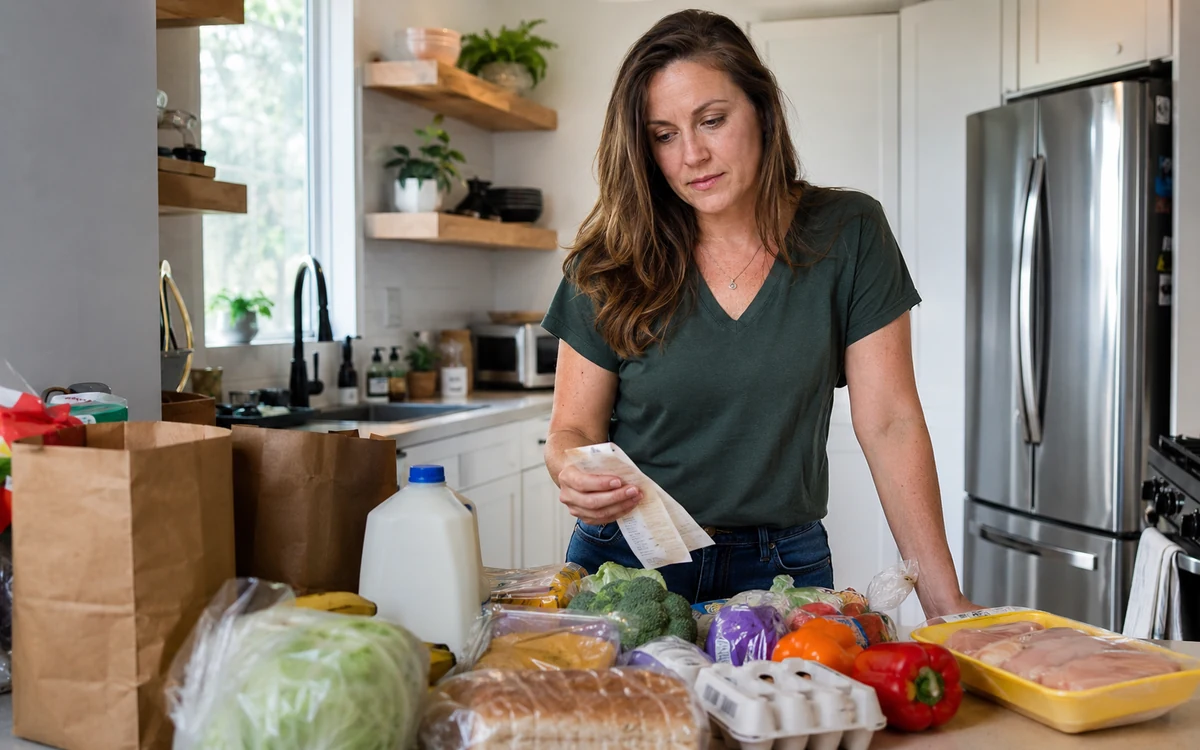
Grocery budget advice usually starts with a number. Spend this much per person. Cut that much per week. Follow this chart. Pretend everyone in your house eats oatmeal with the peaceful obedience of a lab sample.
The problem is that real households are not averages. A retired couple with a small freezer, a family with teenagers, one person who cooks every night, and a household with medical diet needs can all look “wrong” next to the same budget chart. That does not mean they are failing. It means the chart is doing what charts do best: sounding precise while leaving out the messy parts.
A grocery budget only works when it matches what your household actually buys, cooks, stores, and finishes. The useful number is not the one that makes you feel virtuous for three days. It is the number you can repeat without wasting food, skipping meals, or quietly moving restaurant spending into another category so the grocery line looks prettier.
Faye’s rule: I do not start a grocery budget with someone else’s average. I start with three real receipts and what actually got eaten.
Why average grocery numbers can mislead you
Average food-spending numbers are not useless. They can show whether your household is wildly out of range. They can also keep you from thinking you are the only person leaving the grocery store wondering whether cheese has become a luxury investment.
But averages are built for comparison, not household management. The USDA Economic Research Service’s Food Expenditure Series tracks food spending across categories such as food at home and food away from home. The same agency’s Food Price Outlook explains how retail food prices and forecasts are measured.
That context matters because your household may not fit the assumptions behind a broad average. If you live where prices are higher, have limited storage, need special foods, care for an older parent, feed teenagers, or rely on convenience items during a hard season, an average can make a normal household look careless.
The first misleading number: cost per person
“Cost per person” sounds tidy. It is also one of the quickest ways to make a grocery budget feel broken.
A one-person household does not always spend exactly one-quarter of what a four-person household spends. Some foods are sold in larger packages. Some staples spoil before one person can use them. Smaller households may pay more per serving unless they freeze, share, batch cook, or repeat meals carefully.
Per-person grocery math ignores economies of scale. A large household can often spread staples, seasonings, freezer items, and bulk packages across more meals. A smaller household has to be more selective, because the bargain pack is only a bargain if it gets eaten.
If your household is small, do not judge the budget only by per-person numbers. Look at whether you are buying packages you can actually finish. Sometimes the “bigger value” container is just a slower route to the trash can.
The second misleading number: groceries without restaurant spending
A low grocery number can look impressive until you notice the missing meals. If the grocery budget is low because breakfast, lunch, coffee, takeout, and convenience stops are hiding somewhere else, the household may not be saving money. It may just be sorting the same food cost into different envelopes.
Grocery spending and restaurant spending compete for the same appetite. The Food Expenditure Series separates food at home from food away from home, and that split is useful for household budgeting too. A week of higher grocery spending may be perfectly reasonable if it replaces several restaurant meals.
Do not evaluate your grocery budget by itself if your household also buys many meals away from home. A higher grocery bill may be fine if it replaces expensive convenience meals. A lower grocery bill may be fake progress if the drive-thru line simply took over dinner.
Faye’s rule: I count food as food first. Then I separate groceries, takeout, restaurants, coffee, snacks, and convenience stops.
The third misleading number: the perfect weekly target
Weekly grocery targets are satisfying because they feel controlled. Spend $125 every week. Done. Look at us, pretending produce ripens according to accounting categories.
Real grocery spending is lumpy. One week includes cooking oil, freezer meat, spices, pet food, paper goods, or a warehouse-club trip. Another week is mostly eggs, bananas, and a bag of lettuce you swear you will not betray this time.
A monthly grocery budget usually tells the truth better than a weekly one. If a stock-up week makes you panic, you may underbuy, then spend more later. If a light week makes you feel rich, you may overspend somewhere else.
I like a weekly target as a guardrail, not a courtroom sentence. A household can have a normal weekly range and a monthly ceiling. That way one larger trip does not make the whole plan feel ruined.
The fourth misleading number: unit price without waste
Unit price is useful. I use it constantly. But unit price only tells you what the food costs if you actually use it.
The cheapest ounce is not cheaper if half of it spoils. This is where grocery math gets less glamorous and more honest. A bigger bag of salad, a warehouse pack of fruit, or a bulk meat package may have a better unit price and still be a worse buy for your household.
That is why I do not separate grocery budgeting from the kind of grocery shelf math that reveals which package is actually cheaper. The unit price starts the question. Your storage, appetite, schedule, and leftovers finish it.
Household food waste is not just an environmental topic. It is a budget leak. The item that spoils before anyone eats it did not become cheaper because the price tag looked better.
The fifth misleading number: a budget that ignores household seasonality
Grocery spending changes with seasons of life. Summer can mean more snacks at home. School months can mean lunch supplies. Holidays can mean baking ingredients. Illness can mean convenience foods. Hot weather can mean fewer oven meals and more fast options. Caregiving can change everything.
A good grocery budget has room for predictable changes. If your household spends more every November, every summer, or every time grandchildren visit, that is not a failure. It is a pattern.
The fix is not to scold yourself with the same flat number all year. The fix is to build a normal month, a high month, and a low month. A grocery budget should help you forecast, not act shocked by Thanksgiving for the twentieth year in a row.
Use the three-receipt test before changing anything
Before cutting the budget, pull three recent grocery receipts. If you shop at multiple stores, use one normal trip from each type: your main store, your warehouse club, your quick fill-in store, or your delivery order.
Mark every item into one of five groups:
- Meals you planned and used
- Staples you regularly finish
- Convenience items that prevented takeout
- Duplicates you forgot you had
- Food that spoiled, sat untouched, or sounded better in the store than in your actual life
The goal is not guilt. The goal is evidence. If most of the waste is produce, the budget problem may be planning. If most of it is snacks, the problem may be impulse shopping. If most of it is emergency convenience food, the problem may be schedule pressure, not laziness.
This connects naturally with the pantry reset I use to stop buying duplicates. You cannot budget accurately around food you keep forgetting you already own.
Separate “expensive” from “not worth it”
Some grocery items are expensive and still worth buying. Easy proteins, pre-cut vegetables, freezer meals, or prepared salads may cost more than scratch cooking, but they may also prevent a larger takeout order when everyone is tired and morally opposed to chopping onions.
The real question is whether the item replaces something more expensive or becomes waste. A rotisserie chicken that turns into dinner, lunch, and soup is not the same as a fancy sauce that expires behind the mustard collection.
This is where strict grocery advice often gets silly. It assumes every household has the same time, health, energy, transportation, cooking skill, and freezer space. They do not. A frugal choice that only works for someone with an empty afternoon and a chest freezer is not universal wisdom. It is a hobby with a receipt.
Bulk buying needs its own budget rule
Bulk buying can help, but it can also make the grocery budget look worse before it gets better. A warehouse trip may cover six weeks of rice, paper goods, meat, snacks, or freezer staples. If you treat that as one normal grocery week, the number will look terrifying.
For bulk purchases, divide the cost by how long the item should last. A $60 bulk meat package used over six weeks is not the same budget event as $60 of impulse food for this weekend.
I use the same logic in what I buy in bulk and what I never do. Bulk only saves money when the household has storage, demand, and enough discipline not to turn a value pack into a midnight snack program.
Build your real grocery baseline
Once you have receipts, waste clues, and food-away-from-home context, build a grocery baseline instead of chasing an average.
Use this simple version:
- Add your last full month of grocery spending.
- Add any food-away-from-home spending that groceries could realistically replace.
- Subtract obvious one-time stock-ups that will last more than one month.
- Add back a monthly share of those stock-ups if you use them regularly.
- List the top three wasted categories.
- Pick one habit to change for the next month.
Your first goal is not the lowest grocery budget. It is the most honest one. Once the number reflects reality, you can decide where to trim.
Where to trim first without making life miserable
Start with the food that repeatedly fails your household. Not the food you think you should buy. Not the meals a stranger on the internet cooks with suspicious cheerfulness. The food that actually gets wasted.
Good first cuts usually come from:
- Produce bought without a plan
- Backup snacks no one likes
- Duplicate condiments and pantry items
- Bulk items that expire before they are finished
- Convenience foods that do not actually prevent takeout
- Sale items bought only because the discount looked persuasive
Trim the mismatch before trimming the meals. If your budget cut leaves everyone hungry, annoyed, or ordering pizza by Thursday, it was not a budget. It was a temporary performance.
Faye’s rule: The best grocery cut is the item your household keeps buying and not using. Start there before touching the meals people actually eat.
A better grocery-budget question
Instead of asking, “How much should we spend on groceries?” ask these questions:
- What did we spend last month on all food?
- Which grocery items replaced restaurant spending?
- Which grocery items became waste?
- Which staples do we always finish?
- What did we buy because of a sale, not a plan?
- What convenience items genuinely helped us eat at home?
- What number could we repeat for three months?
Those questions create a budget you can actually use. They also prevent the classic grocery-budget mistake: cutting the number in a way that looks good on paper and collapses in real life.
The bottom line
Grocery budget numbers are useful when they give you context. They are misleading when they become a verdict on a household they do not understand.
The better approach is simple: compare broad averages, then build your own baseline from receipts, waste, storage, eating habits, and the meals your household actually repeats. A grocery budget should lower waste and stress, not turn every dinner into a math quiz with vegetables.
What grocery number has never matched your household: the weekly target, the cost-per-person advice, or the “just buy in bulk” suggestion that seems to assume everyone owns a second freezer?
This also connects with coupon math before calling something a deal and grocery habits that quietly save money, because the cheapest-looking cart is not always the cart that saves the most.